
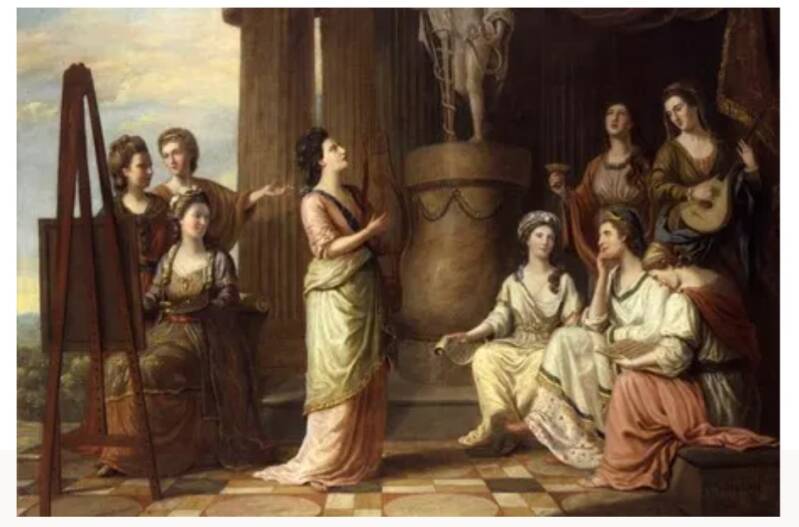
The painting by Richard Samuel: Portraits in the Characters of the Muses in the Temple of Apollo
In today’s episode of The Female Stoic Podcast we are looking at the story of Daedalus and Icarus – a Greek myth – the most famous version being from the 8th century. And we will be relating this to the Stoic Principle of Temperance.
Check out my audiobook Myths and Legends, or tracks on Insight Timer meditation app.
So before we begin, I would like to establish the link between Greek Mythology and the Bluestocking group, who were the inspiration behind this podcast.
Now as you know, from listening to the previous episodes of The Female Stoic Podcast, The Blue Stockings Society was an informal women's social and educational movement in England in the mid-18th century.
It emphasised education and mutual cooperation, and was founded in the early 1750s by Elizabeth Montagu and Elizabeth Vesey and as a literary discussion group, which was a step away from traditional, non-intellectual women's activities.
Both men and women were invited to attend, including the botanist, translator and publisher Benjamin Stillingfleet, who, due to his financial standing, did not dress for the occasion as formally as was customary and appeared in everyday, blue worsted stockings.
The society gave rise to the term “Bluestocking”, and referred to the informal quality of the gatherings and the emphasis on conversation rather than fashion.
By the 1770s, it came to describe learned women in general.
The Bluestockings were directly linked to Greek mythology through their contemporary representation as the Nine Muses, the daughters of Zeus who presided over the arts and sciences.
The painting by Richard Samuel: Portraits in the Characters of the Muses in the Temple of Apollo depicts leading female members of the Bluestocking group dressed in classical robes and posing as the Greek Muses – which is a celebration of their intellectual and artistic achievements.
- Angelica Kauffmann (artist) at her easel.
- Elizabeth Carter and Anna Barbauld (writers).
- Elizabeth Sheridan (singer) in the centre with a lyre.
- Charlotte Lennox, Elizabeth Griffith, and Hannah More (writers).
- Catharine Macaulay (historian) holding a parchment, often associated with Clio, the Muse of history.
- Elizabeth Montagu (co-founder and leading figure) seated on the right.
And of course, Beyond this painting, Greek and Roman classics were fundamental to the Bluestockings' identity and activities. Such as:
- Classical Education: The women of the circle were known for their exceptional education, which often included the study of Greek and Latin at a time when such scholarship was considered "unbecoming" for women.
- Translation of Greek Works: Elizabeth Carter, as we’ve previously heard in early episodes, a prodigious classicist and close friend of Montagu, who translated the complete works of the Stoic philosopher Epictetus from Greek, a project that took nine years and was widely acclaimed.
- Intellectual Identity: And this use of classical references was a deliberate strategy to reinforce the legitimacy of their modern intellectual pursuits and present female learning as a virtuous and nationalistic ideal.
- Satire and Backlash: Even the bluestocking label itself was eventually used in satire by critics like Lord Byron, who twisted the image to mock intellectual women, showing how their challenge to traditional gender norms could lead to classical allusions being used both in praise and derision.
In essence, Greek mythology provided the Bluestockings and their admirers with a rich, authoritative framework to celebrate female intellect and creativity in a patriarchal society.
The story of Daedalus and Icarus:
On the island of Crete there lived a ferocious creature that was half man and half bull called a Minotaur. It loved nothing more than to feast on human flesh.
King Minos believed that his enemies deserved the fate of being fed to the minotaur. He enlisted the help of Daedalus, a talented architect, to build a labyrinth – a maze of passages that would be so complex that it would be virtually impossible for anything to ever find a way out.
Once the Minotaur was in the labyrinth King Minos decided he had no further use for Daedalus, the King threw him into the labyrinth along with his son Icarus.
The King expected that the inventor and his son would be found by the Minotaur and eaten. Instead, unknown to the king, they escaped. After all, Daedalus had built the labyrinth and knew his way around!
Having escaped, Daedulus and Icarus make their way to the shore of the island and ponder on what to do next.
They could not swim, the nearest land was too far away, and they would never make it. They could not leave by ship; all vessels were controlled by King Minos.
Daedalus stared up at the sky and the seagulls and decided he would build a set of wings with which to fly away.
‘With these wings you will fly like a bird,’ Daedalus told his son, ‘but be careful. Make sure you do not fly too close to the Sun. If you do, the wax that holds the feathers together will melt.’
Icarus nodded. In truth he was barely listening.
They donned the wings and began to fly. But too late Icarus realised his wings were melting. He’d flown too close to the Sun..
‘Father!’ he shouted before falling with a heavy splash into the sea, never to be seen again.
This myth is a classic cautionary tale about
Hubris (extreme arrogance)
Ambition
and the Dangers of Overreaching Human Limits.
It laments the tragic consequences of unchecked desire.
It encourages us to balance invention with moderation.
It prompts us to be moderate in our self-praise and acknowledgement of achievement
Themes
- Hubris is represented in Icarus's soaring towards the sun He believes he is god-like and can defy natural boundaries
- Moderation is represented in Daedalus's warning to fly neither too high or low: low to the sea which will dampen the feathers, high to the sun which will melt the wax
- Technology and human ingenuity versus Nature is represented in Daedalus's wings which symbolise intellect, creativity, and the drive for discovery, AND the potential for technology to go wrong when misused.
- Disobedience & Generational Conflict represented by Icarus's failure to heed his father's vital advice highlights youthful recklessness and the classic conflict between experienced wisdom and impulsive youth.
The story serves as a timeless warning that unchecked ambition, pleasure-seeking, and a disregard for consequences lead to downfall, a message relevant to innovation and personal growth. Daedalus's survival leaves him with lifelong grief, showing the personal cost of his invention and his son's fatal ambition, with the sea claiming Icarus while life continues for others
Stoic take on this:
As stoics, Voluntary Simplicity is what we are aiming for.
To detach from an un-managed un-regulated materialistic drive, and focus on inner growth. This may in itself result in wealth, but wealth is not our driving force behind inner growth.
To practise Temperance, we are seeking to become more psychologically resilient
To build mental toughness, reduce fear of loss of material things, and appreciate simple things
Marcus Aurelius stressed enjoying life's gifts without attachment, being content with only what we need, and maintaining inner discipline amidst life’s ups and downs, always retaining that deep connection with our inner virtue
Marcus Aurelius:
The Mind, unmastered by passions, is a very citadel, for a man has no fortress more impregnable wherein to find refuge and be untaken for ever
Epictetus:
"Wealth consists not in having great possessions, but in having few wants".
Here is specific Stoic advice on dealing with the desire for too many things:
- Master the "Dichotomy of Control"
The foundational Stoic principle is distinguishing between what you can control and what you cannot. Your desires for external things (wealth, status, possessions, or even a specific outcome) are largely outside your direct control. By pinning your happiness to these externals, you give them power over your inner peace. Focus your energy instead on what you can control: your own actions and mindset.
- Practice Gratitude and "Want What You Have"
Shift your perspective to appreciate the blessings you already possess. A useful exercise is to regularly meditate on how you would feel if you suddenly lost the things and people you cherish. This helps foster gratitude for your current situation and reduces the longing for more.
- Redefine "Wealth" as "Few Wants"
As Epictetus said, "Wealth consists not in having great possessions, but in having few wants". A person with a natural, healthy want (e.g., one sandwich for lunch) is satisfied upon getting it. An "unhealthy want" is a bottomless pit, spiraling out of control and leaving you forever feeling impoverished, regardless of how much you accumulate.
- Question the Necessity of Your Desires
Regularly ask yourself if the things you are chasing are truly essential for a good life. Marcus Aurelius advised asking at every moment, "Is this necessary?" Most of what we do is not essential and can distract us from focusing on purpose, virtue, and wisdom.
- Focus on the Process, Not the Outcome
Instead of desiring a specific outcome (e.g., getting a promotion), focus on acting with justice, self-control, and wisdom in your current endeavors (e.g., working diligently and helping others). If you have a goal, focus on the deliberate actions required to get there, not the hope or wish for it to happen.
- Embrace Voluntary Discomfort
To build resilience against the need for constant comfort and pleasure, the Stoics recommended practicing voluntary hardship. This could be taking a cold shower, fasting for a period, or temporarily going without certain conveniences. This practice reminds you that you can endure discomfort and helps break the addictive cycle of wanting more.
And how will this benefit us?
Let’s go to the journal task for this week
Think of a time you were driven by an untempered desire to achieve something. A time when you were warned abut excess, yet took that chance and carried on regardless, a time you had an unfettered desire for something, a time you were so hyper focused on obtaining something, nothing else seemed to matter.
Write down one line that describes the place you were in and what you desired.
Now it is time to look more closely at that.
Let’s look at how Temperance could have benefited you at that time.
Temperance:
A temperate person is master of themselves, not a victim of their passions. This virtue ensures the will's mastery over instincts, providing the inner strength to manage impulses and emotions like anger or craving.
By exercising control over desires, we gain the freedom to make conscious choices rather than acting out of compulsion. This liberation from being a "slave to our appetites" allows for deliberate, intentional living.
Temperance helps integrate desires under the guidance of reason, preventing internal conflict and leading to a well-ordered soul, genuine peace of mind, and contentment.
Self-control is linked to better physical health (e.g., improved diet and exercise habits) and enhanced mental well-being (e.g., reduced stress and anxiety). It is foundational to holistic health.
Practicing moderation allows us to step back, reflect, and make thoughtful decisions aligned with our values and long-term objectives, rather than being swayed by fleeting desires or the pull of "more".
Temperance improves interactions by fostering patience and understanding, helping individuals avoid overreactions, communicate effectively, and resolve conflicts peacefully.
The foundation of self-control built by temperance makes individuals more resilient in the face of adversity, trials, and setbacks, providing the spiritual courage to endure suffering and withstand fierce opposition.
By focusing energy on higher pursuits, whether intellectual, creative, or spiritual, temperance helps individuals build character, grow in purpose, and achieve their full potential.
Ultimately, practicing temperance shifts focus from temporary pleasures to lasting fulfilment, enabling a more balanced, purposeful, and fulfilling life in harmony with our higher goals and values.